 The Marketer
AI has become one of the most powerful tools in a marketer’s arsenal, but not all marketers are using it to its full potential. While many rely on ChatGPT for simple tasks—writing captions, generating ideas, or improving grammar—the real magic happens when you understand how to engineer prompts, build workflows, and use AI as a creative, strategic partner.
In 2026, marketers who know how to “hack” ChatGPT aren’t just saving time. They’re producing better content, making smarter decisions, and unlocking insights that competitors miss. Whether you’re a content marketer, performance marketer, social media strategist, brand marketer, or founder building your own marketing engine, this guide breaks down the most powerful ChatGPT hacks every marketer should know.
1. Use ChatGPT as a Research Analyst (Not Just a Writer)
Most marketers use ChatGPT to write, but far fewer use it to think. One of the best hacks is treating ChatGPT like a research assistant that can summarize trends, compare industries, or explain complex concepts in minutes.
For example, you can ask ChatGPT to break down:
- Why a certain demographic behaves the way it does
- What messaging resonates in a niche industry
- How consumer psychology impacts buying decisions
- Differences between platforms (e.g., TikTok vs. Instagram vs. YouTube Shorts)
The key is to ask for structured research, not generic summaries. Ask the model to act as a strategist, analyst, or consultant. When prompted correctly, you can extract detailed market insights that used to take hours of reading, scanning, and note-taking.
2. Build “Custom Personas” to Train ChatGPT to Think Like Your Brand
One of the most valuable hacks for marketers is creating persistent brand personas that ChatGPT can write in consistently. This transforms its output from generic AI-speak into on-brand tone-of-voice content.
Instead of rewriting everything manually, you can upload examples of your past articles, captions, or emails and tell ChatGPT to:
- Analyze voice, tone, rhythm, and style
- Identify patterns
- Reproduce the tone consistently in future content
Once ChatGPT understands your brand voice, it can generate:
- Landing pages
- Sales emails
- Ad copy
- Blog articles
- Instagram posts
- Scripts
- Replies to customer reviews
This hack ensures AI becomes an extension of your brand—not a risk to your brand identity.
3. Use ChatGPT to Build Full Marketing Systems, Not Just Content
ChatGPT isn’t just a writing assistant—it’s a system builder. You can ask it to create entire frameworks and processes such as:
- Monthly content calendars
- Paid ads testing frameworks
- Email nurture sequences
- Social media playbooks
- Brand storytelling guides
- Product launch strategies
Instead of asking ChatGPT for individual assets, ask it for the system that produces assets.
For example:
“Create a 30-day TikTok content strategy with growth objectives, thematic pillars, daily prompts, and posting schedules.”
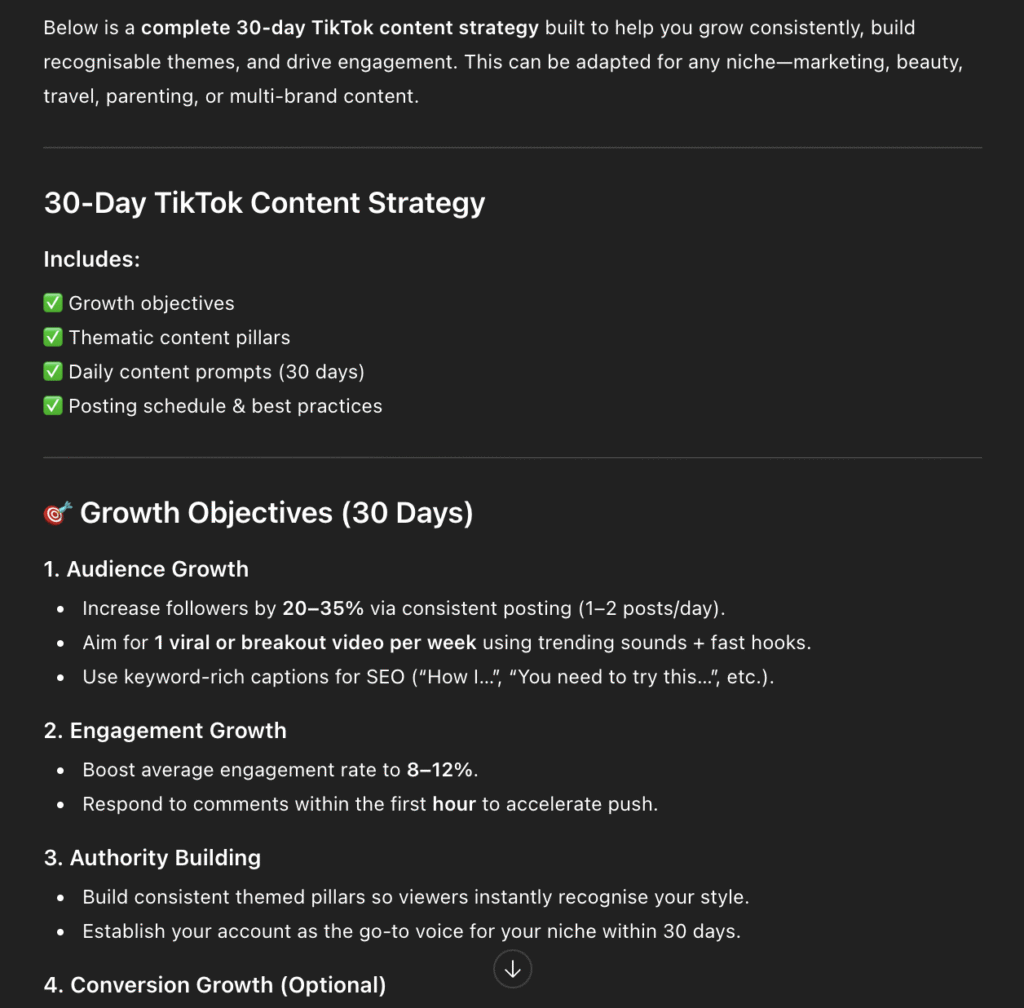
This gives you the structure, then you can zoom in and generate each post, script, or caption when needed. It’s like having a full marketing team in one AI.
4. Use ChatGPT as a Funnel Optimizer
Marketers often look at funnels as a series of disjointed parts—landing pages, emails, ads, offers. ChatGPT can help you evaluate your funnel holistically.
You can upload:
- Landing page copy
- Ads
- Emails
- Sales scripts
- Onboarding flows
- Checkout pages
Then tell ChatGPT to:
- Identify leaks
- Suggest conversion improvements
- Rewrite copy to increase urgency, clarity, or trust
- Recommend A/B test ideas
- Compare your funnel against best practices
This hack is exceptionally powerful for performance marketers and growth teams who want faster, data-informed iteration cycles.
5. Create an AI-Powered Competitor Analysis Engine
Competitor research is one of the most time-consuming tasks in marketing. ChatGPT drastically reduces the workload by organizing, analyzing, and summarizing competitive data.
Ask ChatGPT to:
- Compare competitor positioning
- Identify gaps in their messaging
- Highlight patterns in reviews
- Analyze website copy
- Evaluate their social strategy
- Suggest opportunities to outperform them
Upload competitor landing pages or ads and let ChatGPT show you where they’re strong—and where they’re weak.
With the right prompt, it becomes a full-scale competitive intelligence tool that would normally require a strategist and researcher.
6. Master Prompt-Chaining for More Powerful Outputs
Prompt-chaining is the practice of breaking a large, complex task into a sequence of smaller prompts so ChatGPT can think more deeply.
For example, instead of directly asking ChatGPT to “write a 1500-word SEO article,” you can chain these prompts:
- “Outline the structure you recommend for this topic.”
- “Expand on each section with examples and expert insights.”
- “Rewrite the article in a polished, editorial tone.”
- “Optimize it for SEO with keywords and subheaders.”
This produces work that’s far more nuanced, accurate, and human-like. It’s one of the biggest hacks professional AI marketers swear by.
7. Create Multiple Versions of Yourself for Different Tasks
You can instruct ChatGPT to act as:
- A strict editor
- A growth marketer
- A performance marketer
- A creative director
- A psychology expert
- A pricing strategist
- A brand storyteller
- A data analyst
Each “persona” gives you a different style of thinking. This is incredibly useful when you need input from multiple angles but don’t have a full team.
8. Use ChatGPT to Train Junior Team Members and Interns
If you lead a marketing team, ChatGPT becomes a virtual educator. You can use it to create:
- SOPs (standard operating procedures)
- Training manuals
- How-to guides
- Playbooks
- Onboarding modules
- Skill assessments
This ensures new team members ramp up faster—and makes your internal marketing knowledge scalable.
9. Turn ChatGPT Into a Data Interpretation Assistant
ChatGPT doesn’t just generate text—it can explain numbers. Upload Google Analytics data, ad performance reports, or email metrics and ask it to:
- Interpret trends
- Explain anomalies
- Recommend next steps
- Suggest optimization ideas
- Identify wasted spend
- Predict future performance
This is especially powerful for marketers who aren’t deeply analytical but still need actionable insights.
10. Use ChatGPT as a Brainstorming Partner (Not a Replacement)
The most underrated hack is using ChatGPT to collaborate with you. Ask it for:
- 50 TikTok ideas
- 30 hooks for a sales video
- 20 headlines for ads
- 10 value propositions
- 5 storytelling angles
Then refine together. The idea is not to let AI replace creativity—but to multiply it. You bring the experience, nuance, and brand context; ChatGPT brings speed, structure, and variation.
11. Repurpose Content Automatically Across Platforms
ChatGPT excels at transforming one piece of content into multiple formats, saving hours of work. You can convert:
- A long-form blog into social posts
- A webinar into email sequences
- A podcast into scripts or summaries
- TikTok videos into LinkedIn posts
- A sales deck into website copy
This is one of the most powerful time-saving hacks because repurposing is essential for consistent marketing—but often the most neglected part.
12. Use ChatGPT to Build Sales-Ready Messaging
ChatGPT helps marketers translate features into benefits, write smarter CTAs, and craft buyer psychology-driven messaging. You can ask it to:
- Rewrite copy for emotional impact
- Add urgency without sounding salesy
- Turn technical features into customer benefits
- Improve storytelling
- Strengthen value propositions
With the right prompts, ChatGPT becomes a messaging strategist—not just a writer.
13. Use “Role-Based Prompting” for Better Output
ChatGPT responds better when you frame tasks with roles. For example:
- “Act as a CMO and analyze this campaign.”
- “Act as a behavioral psychologist and explain why this message resonates.”
- “Act as a customer and tell me what makes you hesitate.”
Role-based prompting creates deeper insights and higher-quality recommendations.
This hack alone can elevate your strategy sessions dramatically.
14. Use ChatGPT as Your Personal Creative Director
AI can provide fresh creative direction that cuts through tired industry norms. Ask it to:
- Rewrite a brand story in different styles
- Suggest visual themes
- Recommend campaign concepts
- Create moodboards (descriptions)
- Develop brand aesthetics
It’s a great way to explore creative territory quickly before committing to a full studio production.
15. Build “AI Templates” You Can Use Over and Over
Marketers save the most time when they create templates for:
- Blog posts
- Ad scripts
- Landing pages
- Outreach emails
- Social post formats
- Product descriptions
- Sales decks
You can save these templates inside ChatGPT and re-run them anytime, guaranteeing consistency across content.
Conclusion: Marketers Who Understand AI Will Outpace Those Who Don’t
AI isn’t replacing marketers—but it is replacing marketers who refuse to adapt. ChatGPT gives you leverage: faster research, clearer insights, stronger content, better messaging, and scalable systems.
The best marketers in 2025 aren’t the ones who write the fastest. They’re the ones who prompt the best, think strategically with AI, and build workflows that compound over time.
Use these ChatGPT hacks to elevate your output, sharpen your strategy, and gain a competitive edge in an industry that changes faster than ever.
